

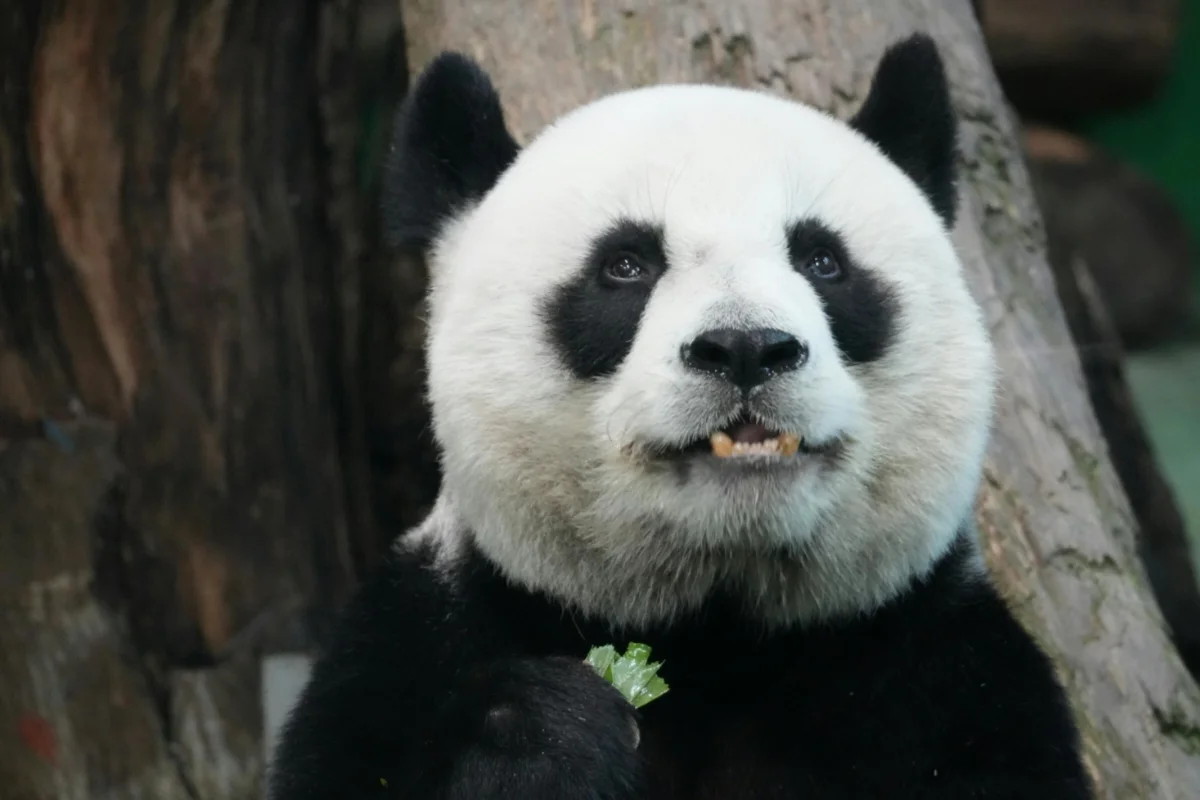
The giant panda (Ailuropoda melanoleuca) is a large black-and-white bear native to the misty mountain forests of central China. Recognized worldwide as a symbol of conservation, this bamboo-eating mammal is classified as Vulnerable by the International Union for Conservation of Nature (IUCN), with roughly 1,864 individuals living in the wild and more than 600 in managed care.
Key facts
- Scientific name: Ailuropoda melanoleuca
- Family: Ursidae (bear family)
- Wild population: ≈1,864 (as of 2024)
- Habitat: Bamboo forests, 1,200–3,400 m elevation, Sichuan-Shaanxi-Gansu provinces
- Diet: 90–98 % bamboo; omnivorous by anatomy
- IUCN status: Vulnerable
Physical traits
Adult pandas measure 1.2–1.9 m long and weigh 70–160 kg, males being larger. Their thick woolly coat is white with black patches on the eyes, ears, limbs, and shoulders. A unique enlarged wrist bone acts as a “pseudo-thumb,” allowing them to grasp bamboo stalks deftly. They are capable climbers and swimmers but spend most of their time on the ground feeding or resting.
Behavior and reproduction
Giant pandas are solitary animals whose home ranges often overlap. They communicate primarily through scent marks and occasional vocalizations. Females come into estrus only once a year for two to three days in spring. After a gestation that includes delayed implantation, usually one cub is born weighing about 100–200 g—among the smallest newborn-to-mother weight ratios in mammals. Cubs remain with their mothers for up to two years.
Diet and ecology
Although taxonomically carnivorous, the panda subsists almost entirely on bamboo leaves, shoots, and stems, consuming 12–38 kg daily. Because bamboo is low in nutrients, pandas feed up to 12 hours a day and produce frequent waste. In their forest ecosystems they act as an umbrella species—protecting panda habitat conserves many other species sharing the same range.
Conservation status
Once widespread across eastern Asia, the species now survives only in fragmented habitats along the eastern edge of the Tibetan Plateau. Chinese and international programs—such as expansive reserve networks, reforestation, and coordinated captive-breeding efforts—have increased populations enough to shift the IUCN rating from Endangered to Vulnerable in 2016. The giant panda remains China’s national treasure and a global emblem of wildlife protection.