
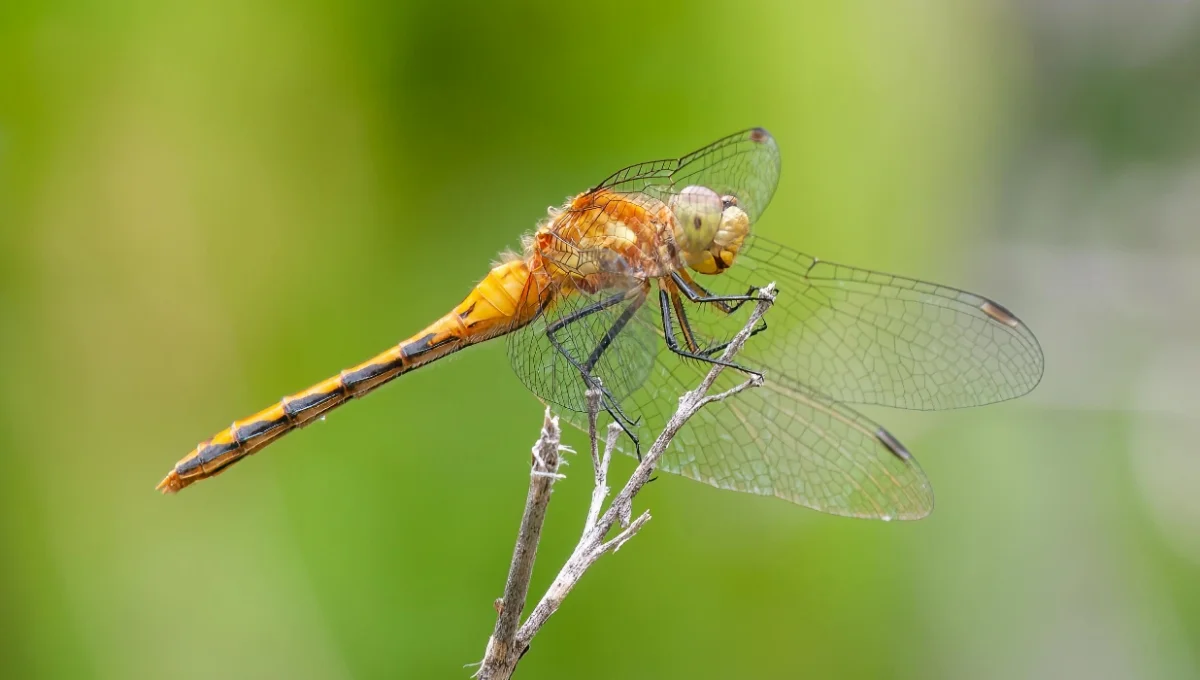
Dragonflies are fast-flying predatory insects of the suborder Anisoptera, within the order Odonata. They are characterized by large multifaceted eyes, two pairs of strong transparent wings, and elongated bodies. Dragonflies are notable for their agility and play crucial ecological roles as both predators and indicators of healthy freshwater habitats.
Key facts
- Scientific classification: Animalia → Arthropoda → Insecta → Odonata → Anisoptera
- Wingspan: 2–19 cm depending on species
- Diet: Carnivorous—feeds on mosquitoes, flies, and small insects
- Habitat: Near freshwater lakes, rivers, and wetlands
- Lifespan: 6 months to several years (mostly in aquatic nymph stage)
Anatomy and flight
Dragonflies possess two independently controlled pairs of wings, enabling precise aerial maneuvers such as hovering, backward flight, and sudden acceleration. Their compound eyes contain up to 30,000 ommatidia, providing nearly 360-degree vision crucial for hunting. The thorax is heavily muscled to support rapid wing beats, while the slender abdomen aids balance and aerodynamics.
Life cycle
Dragonflies undergo incomplete metamorphosis: egg → aquatic nymph (naiad) → adult. The nymph stage, lasting months to years, occurs underwater where larvae are voracious predators of aquatic invertebrates and small fish. After molting several times, nymphs emerge from the water, shed their exoskeleton, and transform into winged adults.
Behavior and ecology
Adult dragonflies are territorial hunters, capturing prey mid-air with basket-like legs. They play a vital role in controlling mosquito populations and serve as bioindicators of freshwater ecosystem quality. Mating involves a distinctive “wheel” position, and females often lay eggs in or near water.
Diversity and distribution
Over 3,000 species of dragonflies exist worldwide, with the greatest diversity in tropical regions. Prominent families include Libellulidae (skimmers), Aeshnidae (darners), and Gomphidae (clubtails). Fossil records trace their ancestry back over 300 million years, making them one of the oldest known groups of flying insects.
Interesting Facts
- Dragonflies are ancient insects that lived before the dinosaurs.
- They can fly forward, backward, sideways, and hover in one spot.
- Dragonflies have large eyes that give them nearly 360-degree vision.
- They are expert hunters and catch insects while flying.
- Dragonflies have four wings that move independently for better control.
- Young dragonflies spend most of their early life underwater.
- Some dragonflies can fly as fast as 50 km/h (30 mph).
- They help control mosquitoes by eating them regularly.
- Many dragonflies have bright metallic blue, green, red, or golden colors.
- Dragonflies are found near ponds, lakes, rivers, and wetlands worldwide.